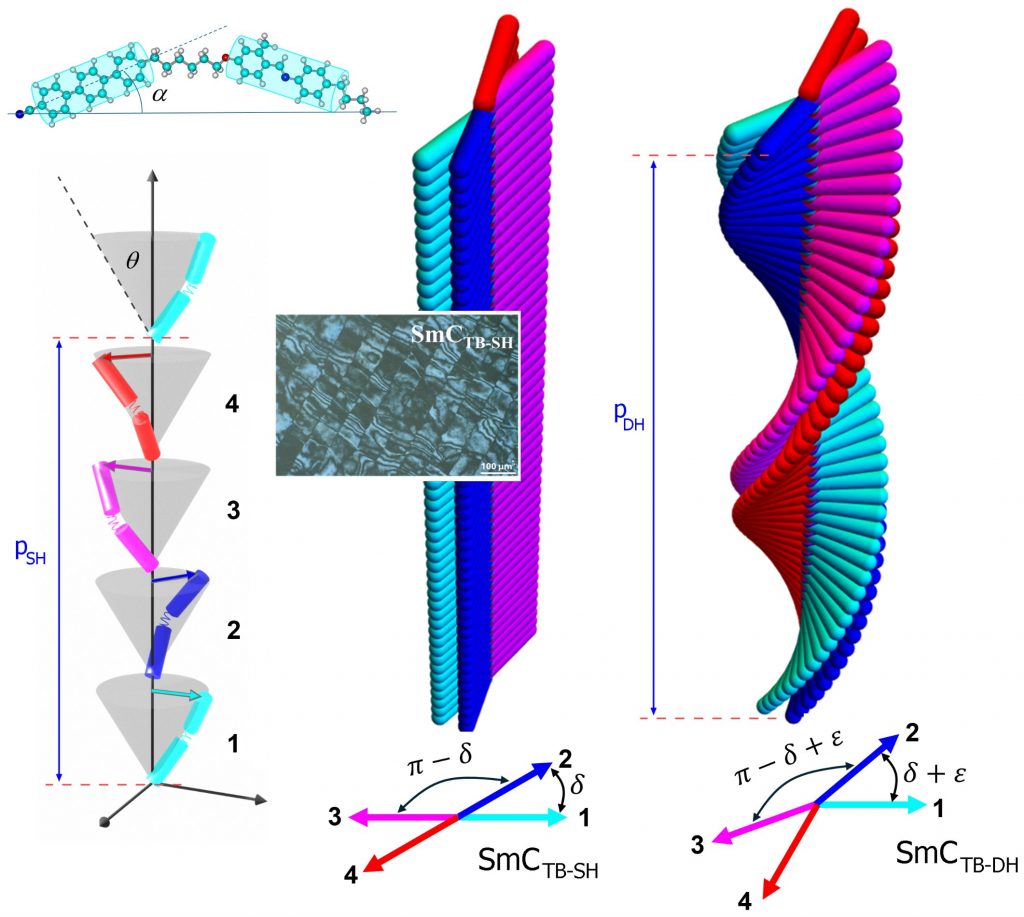


How can complex helical structures emerge from achiral molecules?
22 07 2026
A research article entitled “Diverse helical structures made of achiral mesogenic dimers” has been published in Nature Communications. The paper was co-authored by Prof. dr hab. Ewa Górecka, dr hab. Damian Pociecha, prof. ucz., Dr Grant James Strachan, and Dr Magda Majewska from the Faculty of Chemistry, University of Warsaw.
How can complex helical structures emerge from achiral molecules? In their latest study, researchers from the University of Warsaw, the University of Aberdeen, and the University of Maribor describe an extraordinary diversity of spontaneously formed helical structures in liquid crystals. Their results demonstrate that even completely achiral molecules can self-assemble into complex twisted architectures with multiple levels of structural organization. The study provides new insights into the mechanisms of spontaneous mirror-symmetry breaking in soft matter and significantly advances our understanding of molecular self-organization. A deeper understanding of these phenomena opens new opportunities for the design of advanced functional materials with tailored optical, photonic, and sensing properties.
Diverse helical structures made of achiral mesogenic dimers
A. Pearson, A. Alshammari, G. J. Strachan, M. Majewska, D. Pociecha, J. M. D. Storey, C. T. Imrie, N. Vaupotič, R. Walker, E. Górecka
Nature Communications (2026)
https://doi.org/10.1038/s41467-026-72565-8