Innovative Organogel at the Service of Art Conservation – A Success of Interdisciplinary Collaboration
17 07 2026
An article describing interdisciplinary research resulting from the collaboration of Dr. Klaudia Kaniewska and Dr. Hab. Marcin Karbarz, University Professor from the Faculty of Chemistry at the University of Warsaw, alongside Anna Litwin and Dr. Hab. Anna Sękowska, Professor of the Jan Matejko Academy of Fine Arts in Kraków, and Dr. Elżbieta Pilecka-Pietrusińska from the National Museum in Warsaw, has been published in the journal Journal of Cultural Heritage.
The subject of the research was the preparation and novel application of an advanced nanocomposite material—an organogel. This material was utilized for the precise removal of a degrading emulsion mass from the reverse side of a painting by the prominent Polish painter Włodzimierz Tetmajer, sourced from the collection of the Silesian Museum in Katowice.
The paper presents highly satisfactory results of the organogel application that are completely safe for the canvas structure. It also details the multi-stage conservation process. The development of such a selective and effective cleaning material represents a milestone in the conservation and restoration of easel painting. It demonstrates how the synergy of advanced macromolecular chemistry and traditional conservation techniques can address the most formidable challenges in heritage preservation.
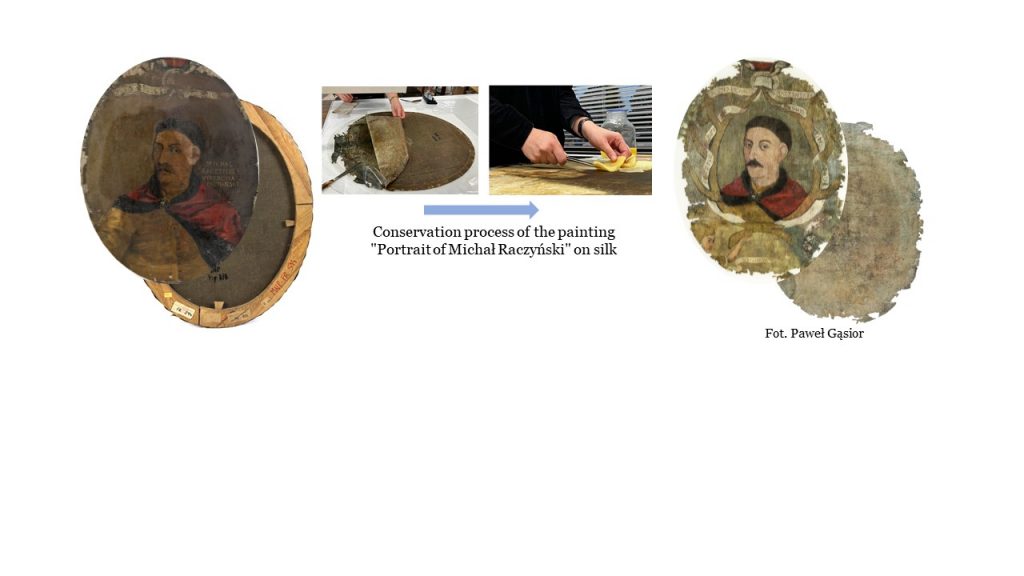
This work exemplifies the research conducted for several years by the Functional Gel Materials group on the applications of soft materials in the conservation and study of artworks. Subsequent studies, carried out in collaboration with Adrianna Pajdak and Prof. Marta Lempart-Geratowska, revealed that the organogel yields highly successful results in extracting a wax-resin mass from an object painted on silk (Portrait of Michał Kazimierz Raczyński). Even more significantly, the removal of retouches and overpaintings led to the discovery that the studied portrait is, in fact, a fragment of a much larger composition. This discovery forms the basis of a subsequent patent application.
https://www.sciencedirect.com/science/article/pii/S1296207426001093?via%3Dihub