

Gold nanoparticles enable precise tuning of the optical response of blue phase liquid crystals
06 07 2026
A paper entitled “Synergistic Effects of Nanoparticles and Surface Anchoring on Fine-Tuning the Photonic Bandgap in Blue Phase Liquid Crystals” has been published in ACS Nano. The work was carried out under the supervision of Dr. Kamil Orzechowski from the Faculty of Physics, Warsaw University of Technology, and Dr. hab. Wiktor Lewandowski, University Professor, from the Faculty of Chemistry, University of Warsaw. The authors also include Natalia Kowalska, a research and teaching assistant at the Faculty of Chemistry, University of Warsaw, and a doctoral candidate at the University of Warsaw Doctoral School of Exact and Natural Sciences, as well as Martyna Wasiluk, a doctoral candidate at the University of Warsaw Doctoral School of Exact and Natural Sciences conducting her research at the Faculty of Chemistry, University of Warsaw.
Materials that strongly interact with light and whose optical response can be precisely and controllably modified are becoming increasingly important for photonics, next-generation displays, optical filters, and sensors. Particularly interesting in this context are blue phase liquid crystals (BPLCs), structures capable of selectively reflecting circularly polarized light of a defined handedness. However, achieving both a broad tuning range of the reflected wavelength and a high level of control over the BPLC structure has so far remained a significant challenge.
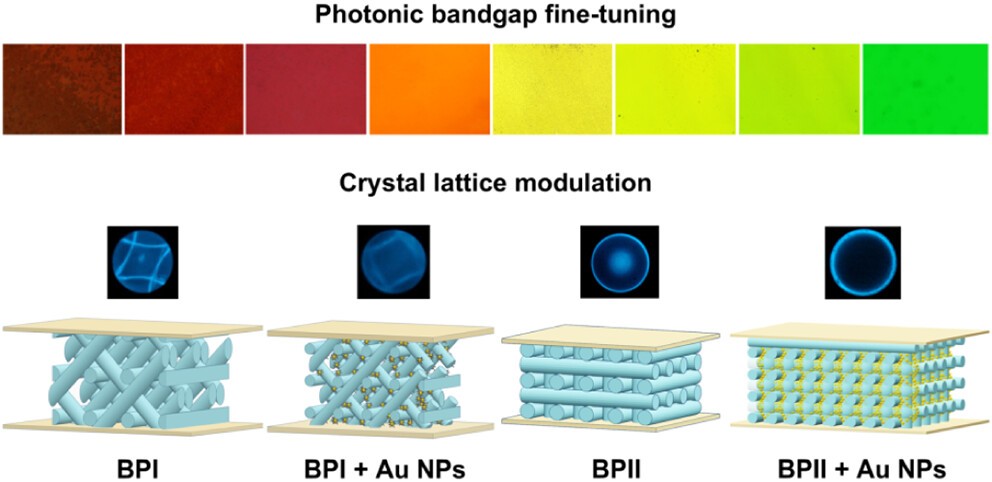
In this work, we describe a composite material in which the position of the photonic bandgap, and therefore the range of wavelengths selectively reflected by the BPLC, can be regulated using complementary “internal” and “external” factors.
The internal factor is provided by gold nanoparticles designed and synthesized at the Faculty of Chemistry, University of Warsaw, in the group of Dr. hab. Wiktor Lewandowski, University Professor. The nanoparticles, approximately 2.3 nm in diameter, were coated with specially designed ligands structurally resembling liquid-crystalline molecules. As a result, they can effectively interact with the liquid-crystalline matrix and localize within the defect network of the BPLC. The presence of the nanoparticles enhances the chiral twisting of the system, leading to a shortening of the helical pitch and a reduction in the unit cell size. Consequently, the selective reflection of light shifts toward shorter wavelengths. The external factor, in turn, is the use of alignment layers with different surface anchoring energies.
A key achievement of this work, distinguishing it from previous studies on BPLCs, was the realization of a broad yet precise tuning range of the photonic bandgap without disrupting the BPLC structure. This was achieved through the synergistic action of the “internal” and “external” factors.
The work was carried out as part of a broad international collaboration involving teams from the Faculty of Chemistry, University of Warsaw; the Faculty of Physics, Warsaw University of Technology; National Sun Yat-sen University in Taiwan; the Military University of Technology; the Centre of Polymer and Carbon Materials of the Polish Academy of Sciences in Zabrze; and the University of Silesia.
More info: https://doi.org/10.1021/acsnano.6c01127