


Publication in Acta Materialia (2026)
06 03 2026
A scientific paper by the research groups of Prof. Krzysztof Woźniak and Dr hab. Wojciech Sławiński has been published in the Acta Materialia. The study concerns hidden complexity in D2O ice VII. Through coupling Pair Distribution Function and Reverse Monte Carlo modelling to high pressure neutron scattering data, the authors have quantified the atomic and molecular structures of disordered ice VII. The decomposition of the average structure of ice VII into the individual positions of water molecules within the crystal lattice reveals that the D2O molecules are displaced along the direction of the polarization vector of each molecule.
The co-authors of the paper are: Prof. Wojciech A. Sławiński* from our Department, Dr Grzegorz Łach from the Physics Department of our University, Dr Roman Gajda, Dr Michał Chodkiewicz, Dr Piotr Rejnhardt from Prof. Wozniak’s group, Prof. Mihails Arhangelskis from our Department, Dr Christopher J. Ridley from STFC, Rutherford Appleton Laboratory, ISIS Neutron and Muon Source, Chilton UK and Spallation Neutron Source, Oak Ridge National Laboratory, USA, Dr Craig L. Bull from ISIS Chilton, UK and EaStCHEM School of Chemistry, University of Edinburgh, Scotland and Prof. Krzysztof Woźniak* from our Department.
Ice VII is thought to play a role in the water-rich interiors of Jupiter’s moon Europa, Saturn’s moon Enceladus and other planetary bodies. Althow its average cubic structure appears simple, the local structure reveals hidden complexity: individual positions of water molecules forming a complex network via hydrogen bonds. Through coupling Pair Distribution Function and Reverse Monte Carlo modelling to high pressure neutron scattering data, we have quantified the atomic and molecular structures of disordered ice VII. The decomposition of the average structure of ice VII into the individual positions of water molecules within the crystal lattice reveals that the D2O molecules are displaced along the direction of the polarization vector of each molecule. Incorporating this displacement yields a structural model that more accurately reproducs the D–O distances and D–O–D angles determined for other ordered ice structures. Our results are also supported by DFT calculations confirming that deviations of water molecules from their average crystallographic positions energetically stabilize the structure of ice VII. Our results open new perspectives for structural studies of different forms of ice, their phase transitions treating them as vast clusters of molecules with an average periodic structure but symmetry-free local arrangements.
You can also find in the Supplementary Materials short videos showing: – structure of ice VII resulting from our studies and changies of average positions of oxygen atoms as function of refinement progress.
ars.els-cdn.com/content/image/1-s2.0-S1359645425011267-mmc1.mp4
ars.els-cdn.com/content/image/1-s2.0-S1359645425011267-mmc38.mp4
W. A. Sławiński*, G. Łach, R. Gajda, M. Chodkiewicz, P. Rejnhardt, M. Arhangelskis, C. J. Ridley, C. L. Bull, K. Woźniak*, Hidden complexity in D2O Ice VII, Acta Materialia, Volume 305, 15 February 2026, https://doi.org/10.1016/j.actamat.2025.121839
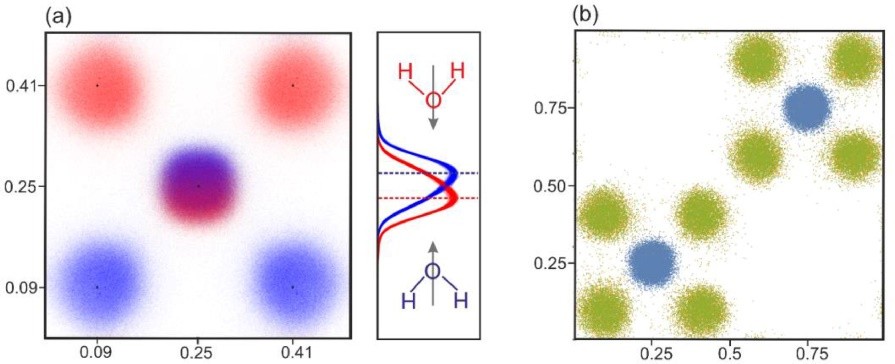
Fig. 2. (a) Detailed distribution of D2O molecules, as obtained from RMC refinement, divided into two groups with dipole moment pointing towards positive vertical direction in blue and negative vertical directions in red. The inset shows the position distribution of the “red” and “blue” D2O molecules and its separation by ca. 0.1 Å. (b) Distributions of D and O atom positions back transformed into a single crystallographic unit cell. H-atom positions in green and oxygen atoms in blue. The PDF data collected at RT and ca. 2.75 GPa pressure.
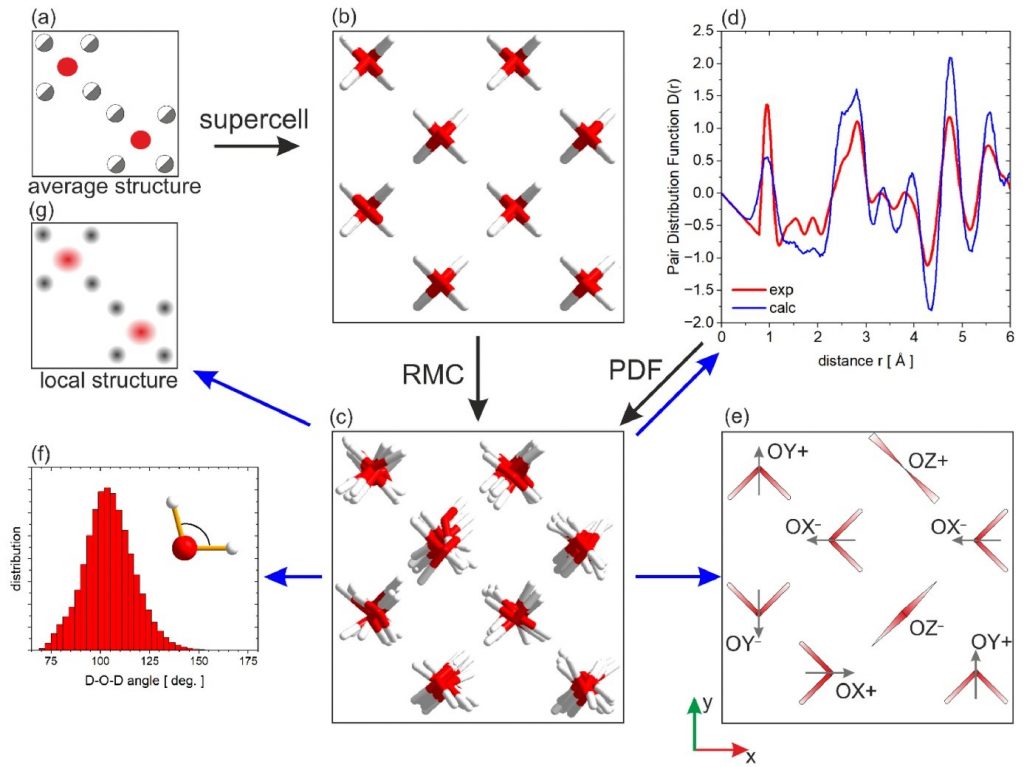
Fig. 1. Schematic illustration of RMC concept of D2O ice VII structure refinement: (a) the average structure based on the Bragg diffraction with the disordered D-atom positions (50 % occupancy), (b) symbolic representation of the created starting supercell configuration (24 × 24 × 24 = 13 824 unit cells containing 82944 atoms), (c) a fragment of Reverse Monte Carlo supercell obtained during the refinement documenting unique individual positions of D2O molecules, (d) experimental and configuration based Pair Distribution Functions, (e) definition of D2O orientations, (f) D-O-D bond angle distribution, (g) result of modelling projected into a single unit cell showing distribution of atomic positions. Red spheres/dot distribution/sticks denote oxygen atoms, and white or grey denote hydrogen atoms. Details of the RMC modelling are defined in the Methods section. The PDF data collected at RT and ca. 2.75 GPa pressure.