

Hybrid ZnBSA Nanostructures for Controlled Ciprofloxacin Release in the Treatment of Bone Infections
06 03 2026
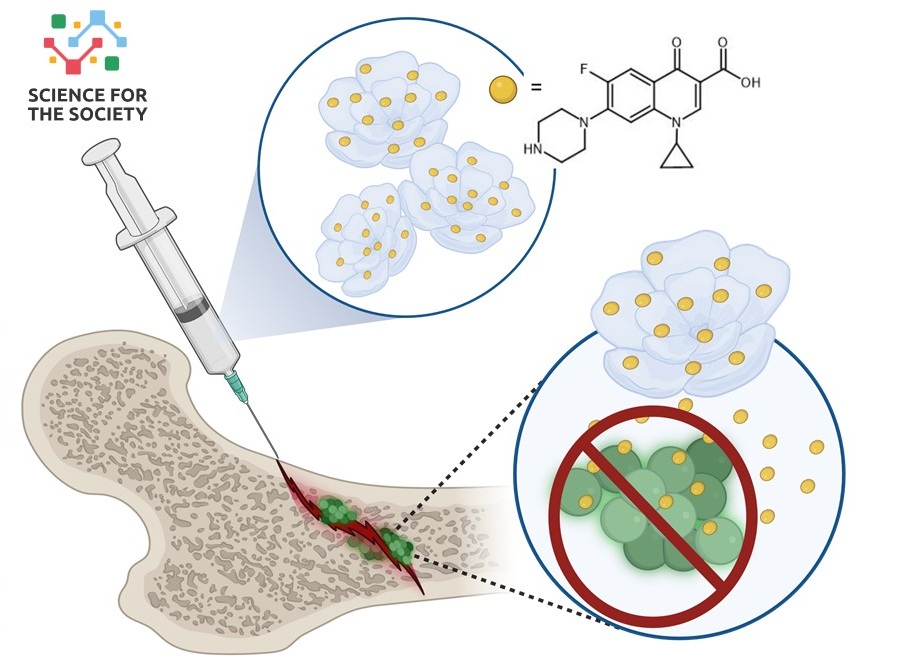
Osteomyelitis is one of the most challenging bacterial infections and often leads to severe bone tissue damage. Effective therapy requires both infection control and support for bone regeneration. To address this challenge, hybrid “nanoflower” nanostructures composed of zinc phosphate and albumin (ZnBSA) were developed. Their structure mimics the organic–inorganic architecture of bone and may serve as a material supporting regenerative processes.
Dr Olga Święch from the Faculty of Chemistry at the University of Warsaw participated in the project “Local antibiotic delivery systems for the treatment of bone and bone marrow infections,” funded by the Polish Ministry of Science and Higher Education under the Science for the Society II programme (No. NdS-II/SP/0335/2023/01). The project is conducted at the Institute of Biocybernetics and Biomedical Engineering of the Polish Academy of Sciences under the leadership of Dr hab. Kamila Sadowska, Professor of the Institute. The research was carried out in collaboration with Gdańsk University of Technology and the Medical University of Lublin.
The study demonstrated that ZnBSA nanostructures enable the loading of ciprofloxacin, an antibiotic used to treat severe bacterial infections, and its controlled release. At the same time, the material exhibited high biocompatibility in studies on erythrocytes, cell lines, and in the in vivo Danio rerio model, while maintaining antibacterial activity against Staphylococcus aureus, Pseudomonas aeruginosa, and Klebsiella pneumoniae. These results indicate that the material may combine structural support with localized antibacterial action.
The results were published in the journal Nanotechnology, Science and Applications (Dove Medical Press Ltd, Taylor & Francis Group, DOI: 10.2147/NSA.S574498).